


Exploring Petrified Forest National Park: Arizona's Rainbow of Stone Trees

Some places in Arizona make you feel small because they are huge. Petrified Forest National Park makes you feel small because it is old. You walk past logs that look like someone left them on the ground last week, then you touch one and it is cold, heavy stone that glitters with quartz in red, orange, purple, and gold. Those trees were growing more than 200 million years ago, when dinosaurs were just getting started.
The park sits off Interstate 40 in northeastern Arizona, east of Holbrook, and it is one of the easiest national parks in the state to see in a single day. A 28-mile scenic road runs north to south through it, linking the pastel badlands of the Painted Desert with the log-strewn hills of the Rainbow Forest. Fall is one of the best times to go: cooler temperatures, softer light, and fewer crowds than summer. Here is how I would plan a day there, what to see, and what to know before you go.
A Rainbow Forest Turned to Stone
About 218 million years ago, in the Late Triassic, this part of Arizona was a warm, wet floodplain crossed by rivers. Tall conifer-like trees grew along the banks. When they fell, some were swept into river channels and buried quickly under mud, sand, and volcanic ash. That burial cut off oxygen and slowed decay.
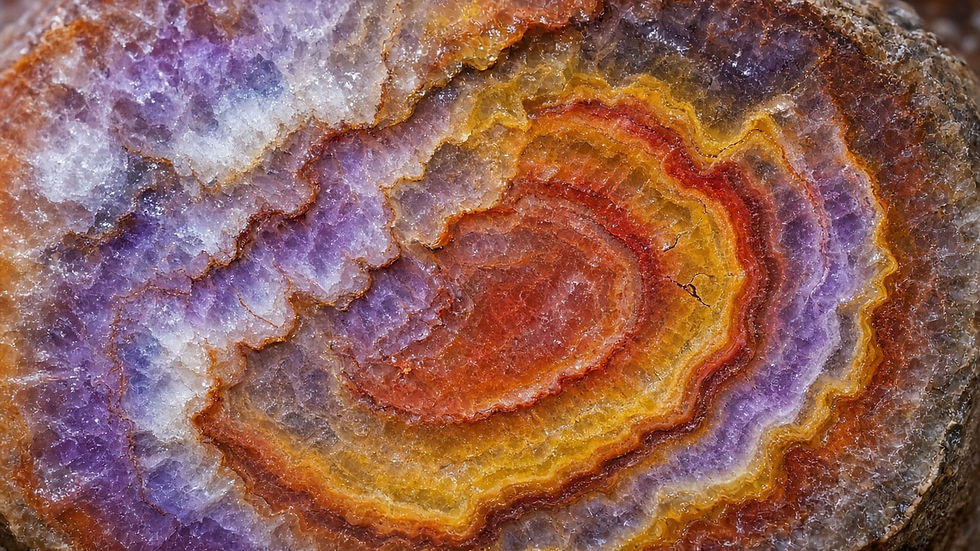
Over time, groundwater rich in silica from the volcanic ash seeped into the wood. The silica slowly filled the cells and spaces in the logs and hardened into quartz, preserving the shape of the trees and sometimes even the bark and growth rings. Trace minerals did the painting: iron oxides make the reds, oranges, and yellows, while manganese and carbon add purples, blues, and blacks. Millions of years of uplift and erosion finally brought those buried logs back to the surface, which is why you see them scattered on the hillsides today.
The rock layers that hold the logs, called the Chinle Formation, are also rich in other fossils: early dinosaurs, giant amphibians, crocodile-like reptiles called phytosaurs, and ancient plants. Paleontologists are still finding new species here.
Plan Your Visit: Hours, Fees, and Getting There
Here are the basics as listed on the official park site (https://www.nps.gov/pefo) at the time of writing. Always check the park's alerts and hours pages right before you go, since things change.
Hours. The park road is open 8 a.m. to 5 p.m., Mountain Standard Time year-round (Arizona time). The Painted Desert Inn is listed at 9 a.m. to 4 p.m. The park is open every day except Thanksgiving and Christmas. Details: https://www.nps.gov/pefo/planyourvisit/hours.htm
Entrance fees. $25 per private vehicle, $20 per motorcycle, and $15 per person on foot or bike, each good for 7 days. A Petrified Forest annual pass is $45, and the America the Beautiful pass covers entry. The park is cashless, so bring a card. Details: https://www.nps.gov/pefo/planyourvisit/fees.htm
Fee-free day. The park service lists October 27 (Theodore Roosevelt's birthday) and November 11 (Veterans Day) among its 2026 fee-free entrance days for U.S. citizens and residents.
Visitor centers. The Painted Desert Visitor Center at the north entrance is currently closed for construction, so the Painted Desert Inn, about 2 miles past the north entrance station, is serving as the north visitor center. The restaurant, gift shop, gas station, and restrooms at the north entrance complex are still open. At the south end, the Rainbow Forest Museum has exhibits, a bookstore, and restrooms. Details: https://www.nps.gov/pefo/planyourvisit/visitorcenters.htm
Getting there. From Phoenix, it is roughly a 3.5 to 4 hour drive either way: north on I-17 and east on I-40 through Flagstaff, or northeast through Payson, Heber, and Holbrook. The north entrance is at I-40 exit 311. The south entrance is on Highway 180, about 19 miles southeast of Holbrook.
Because the road runs straight through, the classic plan is to enter at one end, drive the 28 miles with stops, and exit at the other, then loop back via I-40 and Highway 180 through Holbrook. Budget at least half a day, and a full day if you want to walk several trails.
Painted Desert and the North End
If you start at the north entrance, the first part of the drive follows the rim of the Painted Desert. A series of overlooks, including Tawa Point, Kachina Point, and Chinde Point, look out over rolling badlands banded in red, pink, lavender, and gray. The colors shift through the day, and late afternoon is spectacular.
The Painted Desert Inn National Historic Landmark at Kachina Point is a must. This adobe-style inn dates to the 1920s and 1930s and was later updated by famed architect Mary Colter for the Fred Harvey Company. Inside you will find murals by Hopi artist Fred Kabotie, a small museum, and an ice cream parlor (always a win). From there, the short Painted Desert Rim Trail runs between Tawa Point and Kachina Point with big views the whole way.
A little farther south, the road crosses historic Route 66. A rusted 1932 Studebaker sits at the pullout marking the old alignment, and it is one of the most photographed spots in the park. This is the only national park that protects a section of Route 66.
Puerco Pueblo and Newspaper Rock
People have lived in and traveled through this area for thousands of years. At Puerco Pueblo, a short paved loop of about a third of a mile winds through the remains of a roughly 100-room pueblo built by ancestral Puebloan people more than 600 years ago. Look for petroglyphs on the boulders around the site, including one that interacts with sunlight on the summer solstice.
Just down the road, the Newspaper Rock overlook looks down on a cluster of boulders covered with hundreds of petroglyphs. Bring binoculars, or use the spotting scopes, because the viewing platform is set back to protect the site.
Blue Mesa: My Favorite Short Hike
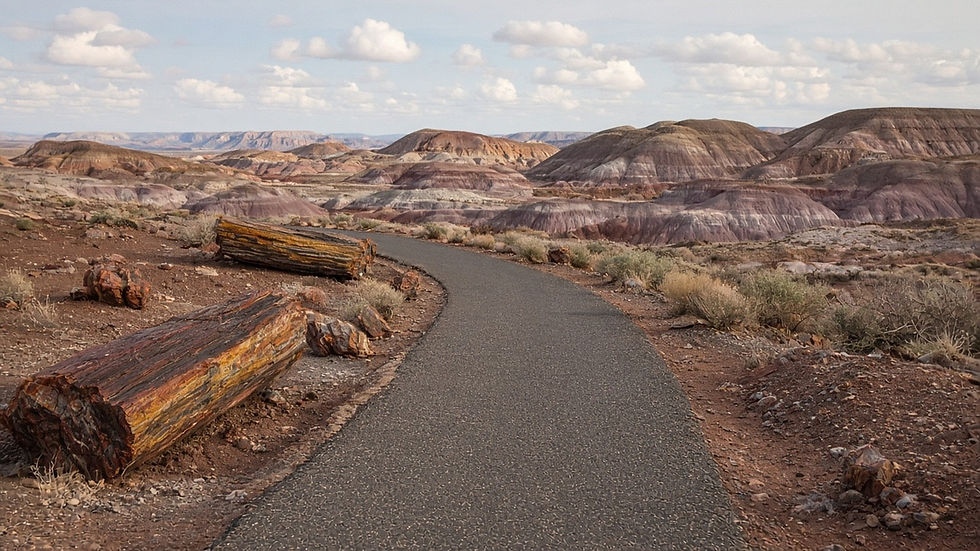
If you only walk one trail, make it Blue Mesa. A spur road climbs onto the mesa, and a roughly 1-mile paved loop drops down into the badlands below. The hills here are banded in blue, purple, and gray clay, with chunks of petrified wood scattered right along the trail. It feels like walking on another planet.
The trail is steep at the start and end, so take your time on the climb back up. In fall the temperatures are usually pleasant, but there is little shade and the elevation is around 5,500 feet, so bring water and sun protection.
Nearby, the Teepees are cone-shaped hills striped with layers of mineral color, and a quick stop at Agate Bridge shows a petrified log that spans a small wash, held up by a concrete support added in the early 1900s.
Jasper Forest and Crystal Forest
Jasper Forest overlook gives you a sweeping view of a valley floor littered with petrified logs that tumbled down as the hills eroded. It is a great place to see just how much wood is out there.
Crystal Forest has a paved loop of about three-quarters of a mile through some of the most colorful logs in the park. Many of them have hollow centers once filled with sparkling quartz and amethyst crystals, which is how the area got its name. Sadly, early souvenir hunters pried out a lot of those crystals in the late 1800s. That kind of damage is one reason the area was protected as a national monument in 1906 and became a national park in 1962.
Rainbow Forest: Giant Logs, Long Logs, and Agate House
The south end of the park has the biggest concentration of logs. Start at the Rainbow Forest Museum, where you can see fossil skeletons and exhibits about Triassic life. The museum's demonstration lab is listed as open Thursday through Saturday with set morning and afternoon hours, where you can sometimes watch paleontologists prepare fossils. Call ahead, because the schedule can change.
Right behind the museum, the Giant Logs trail is a short loop of about 0.4 miles that leads past some of the largest logs in the park, including "Old Faithful," which is close to 10 feet wide at its base.
Across the road, the Long Logs and Agate House trails share a trailhead. Long Logs is a loop of about 1.6 miles past one of the largest concentrations of petrified wood in the park. The Agate House trail, about 2 miles round trip, leads to a small reconstructed pueblo built roughly 900 years ago entirely from blocks of petrified wood. You can combine the two for a longer walk of around 2.5 to 3 miles.
Leave the Wood, Buy a Piece Instead
It is tempting to slip a little chip of rainbow wood into your pocket. Please do not. Removing petrified wood, rocks, or any natural or cultural item from the park is against federal law, and the park asks every visitor to leave it all in place. With hundreds of thousands of visitors a year, even small pieces add up fast.
If you want a souvenir, the gift shops inside and outside the park sell petrified wood collected legally from private land outside the park. Rock shops in Holbrook have everything from tiny polished pieces to whole log sections.
Tips for a Great Fall Visit
Start early or stay late. The light at opening and in the last hour before closing makes the colors glow. Remember the road closes at 5 p.m.
Dress in layers. Fall mornings at this elevation can be chilly, and afternoons can still be warm. Wind is common.
Bring water and snacks. Food and water are limited inside the park, and there is no water in the backcountry.
Pets are welcome. Leashed dogs are allowed on paved roads and trails and in the designated wilderness area, which makes this a rare dog-friendly national park. Pets are not allowed in buildings.
Stay on the trail on paved walks. The badland clays are fragile and erode easily.
Download the audio tour. The park offers a self-guided audio tour you can save before you go, since cell service is spotty.
Look up after dark. Petrified Forest is an International Dark Sky Park. If you stay nearby in Holbrook, the night sky is a treat.
Make It a Northern Arizona Road Trip
Petrified Forest pairs well with other stops in this part of the state. Heading west on I-40, Walnut Canyon near Flagstaff has cliff dwellings tucked into a limestone gorge (our trip guide is here: https://www.greenthumbhobbies.com/post/walnut-canyon). Heading south toward the White Mountains, Fool Hollow Lake in Show Low makes a peaceful overnight stop (https://www.greenthumbhobbies.com/post/fool-hollow-lake). And if ancient dwellings are your thing, Montezuma Castle in the Verde Valley is an easy add on the way home to Phoenix (https://www.greenthumbhobbies.com/post/montezuma-castle).
Wrapping Up
Petrified Forest National Park is one of those places that sounds like a quick roadside stop and then surprises you. Between the pastel Painted Desert, the ancient pueblos and petroglyphs, Route 66 history, and those glittering stone logs, a day here covers more than 200 million years of story. Go on a cool fall day, walk Blue Mesa and Giant Logs at the very least, and leave every piece of that rainbow wood right where you found it.


Comments